Fossil coral is an ancient coral reef that crustal movement has lifted above sea level and exposed on land. A reef that took tens of thousands of years to form beneath the sea, preserved on land exactly as it was — a fossil of the ocean.
Yonaguni Island in Okinawa, the westernmost island of Japan, holds fossil coral formed roughly 100,000 years ago — young, as fossil coral goes. It is a rare material found nowhere else in the world, preserved in massive form just as it was in life. Today, Yonaguni Island is the only source of fossil coral used as food.
Is coral a plant or an animal?
Coral is a genuine animal — a cnidarian, in the same group as sea anemones and jellyfish. What sets it apart from an anemone is that individual polyps divide and replicate to form colonies of hundreds to tens of thousands, and that they build a skeleton whose main component is calcium carbonate, taking in carbon dioxide and calcium from seawater.
The waters from the main island of Okinawa down to the Yaeyama Islands are among the world's great treasuries of coral reef. Many of the Ryukyu Islands are made of limestone layers — reefs formed in this way and later exposed on land through seabed subsidence or crustal uplift.
What makes Yonaguni fossil coral distinctive
1. Young, at about 100,000 years — and therefore high in purity
Because the fossil coral of Yonaguni Island is very young at around 100,000 years, it is free from the fish bones, sea-urchin spines and shell fragments found in older Ryukyu limestone, and is correspondingly high in purity.
2. 74 natural minerals, calcium as the main component
That youth and purity mean it holds 74 marine minerals, including 16 essential minerals. The main component is calcium carbonate; each gram of the powder contains 372 mg of calcium and 6.39 mg of magnesium. Nothing is blended in artificially — these are the minerals the coral took from seawater, still in their natural balance.
3. Porous structure
Fossil coral retains the porous structure of coral, riddled with countless fine pores. This gives it a large surface area, and the powder mixes readily with water. Its adsorptive properties were confirmed in a test report prepared by the Kitasato Institute Environmental Science Center.
4. Aragonite-type calcium carbonate
Calcium carbonate crystallises in two forms: aragonite and calcite. The fossil coral of Yonaguni Island is aragonite, which dissolves readily in water and has weak consolidating behaviour.
How it differs from coral sand (weathered reef coral)
Most products that claim to be "coral-derived" use coral sand (weathered reef coral) collected from the seabed. Internationally the distinction is explicit: fossil coral raised above sea level is called Above-Sea Fossilized Coral, while material from the seabed is Marine Coral.
| Comparison | Fossil coral (Yonaguni Island) | Coral sand (weathered reef coral) |
|---|---|---|
| Where it is collected | Quarried on land as food | Collected from the seabed, largely as building material |
| Fossil coral content | 100% | 13.7% |
| Foraminifera | None | 10.4% |
| Shell fragments | None | 13.7% (coral fragments account for 62.0%, with much foreign material besides) |
| Exposure to marine pollution | Low (quarried on land) | Future exposure cannot be ruled out (collected from the seabed) |
* The comparative analysis is based on content ratios within a 50 g sample, measured by a third-party institution.
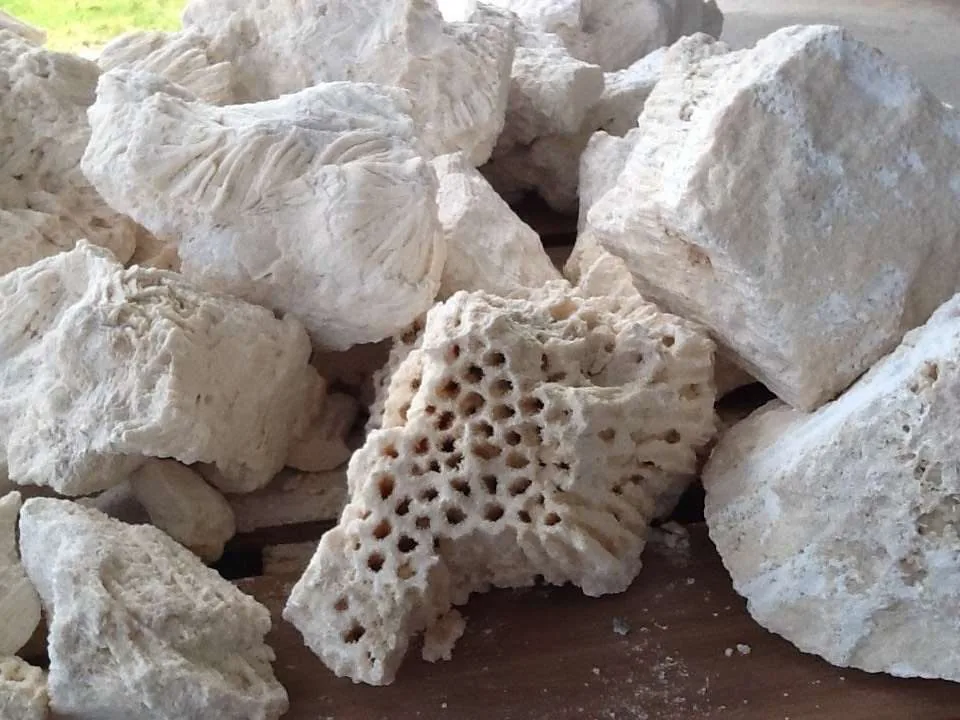
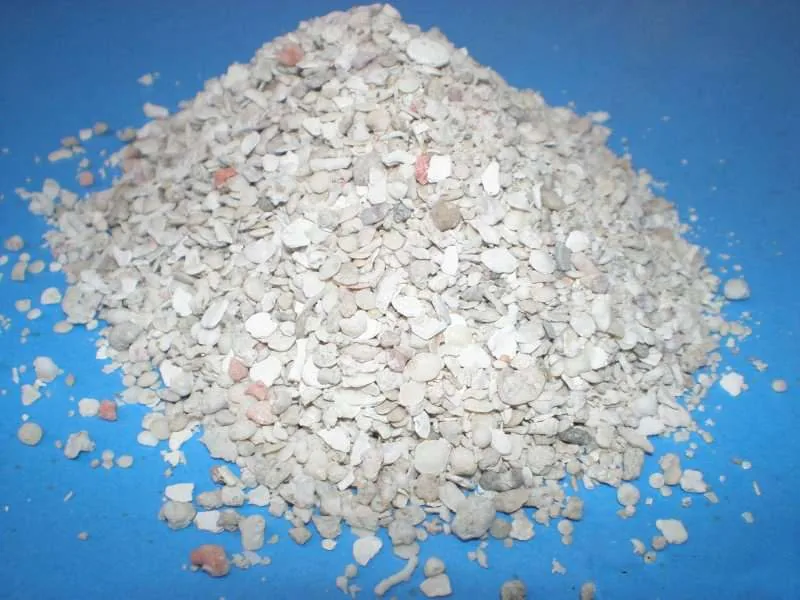
The difference is not only in the data — you can see it. Fossil coral comes in solid pieces with the porous structure intact, whereas coral sand is granular and visibly mixed with shell fragments and other material.
How it differs from fired products — our activation process
Some coral-based powders are processed by firing at 500–1000 °C. Firing at high temperature oxidises the calcium carbonate that forms the main component, altering the minerals.
ACTIVITY 35 is not fired. We activate the fossil coral with our own process, so the minerals are not altered: on contact with water the powder generates hydrogen (measured by gas chromatography) and shifts the water to a weakly alkaline state. In our own oxidation-reduction potential (ORP) measurements, adding the powder to tap water (+500 to +700 mV) shifted the reading to between −100 and −280 mV (for example, Tokyo tap water: +620 mV → −200 mV).
A long history between people and fossil coral
Fossil coral has been used for a very long time. The Chinese Ming-dynasty pharmacopoeia Bencao Gangmu (1578) records fossil coral under the name shizhi, with notes on its use as a drink and in folk medicine, and Spanish records from 1792 describe its medicinal use. In Okinawa it was part of everyday life, used in brown-sugar production and to filter rainwater.
Today, unfired calcium made from fossil coral is designated as a food additive (an existing additive) in Japan and is widely used as a material of recognised safety.
Is it acceptable to take coral? — our approach to the resource
Harvesting living coral is regulated under Japanese national and prefectural law and under the CITES convention, but fossil coral — long dead and now part of a stratum on land — falls outside those rules. We operate our own quarry on Yonaguni Island and extract only modest quantities. We take nothing from the living reef; the gift comes from an ancient sea.
Uplifted coral ground and long-lived communities
Most of mainland Japan sits on volcanic soil, whereas the Amami and Nansei island chains include islands formed by uplifted coral reef. In such places, rainwater passing through the coral strata produces mineral-rich groundwater, and crops are said to be rich in calcium as well. Similar conditions have been reported in the soils of communities known worldwide for longevity.